 Coco Martin (left) is smiling because his career is going so nicely, thank you very much. He employs the savvy modern move of many a contemporary Hollywood star which is to say he alternates between mainstream projects for the fame/money and indie films for the cred. 'One for audiences, one for me' as it were (see also: Clooney, Moore and dozens of American A-listers). The irony for stars outside of the Bollywood and Hollywood mega-systems though is that the "art" or indie projects are really the only way you get fame/money in the international sphere, since that's the stuff that travels and wins international honors in other countriesCoco is the star of the Pinoy Oscar submission Noy which he also co-wrote and co-produced. If you recognize him at all, it's probably as the frequent muse of The Philippines most internationally recogniz! ed director Brillante Dante Mendoza for whom he starred in the violent Cannes lauded/loathed Kinatay, the gay DVD hit The Masseur and in Serbis about a troubled family running a porn theater which had a brief US run.Mendoza has nothing to do with this film, but I bring it up because Coco's next film, a reunion with Brillante Mendoza, is called Captured and will co-star none other than Isabelle Huppert. Talk about reasons for a young actor to smile.
 Coco plus Isabelle for lucky man MendozaI'm pretty sure I compile the foreign film charts each year mostly due to my OCD with movies. Sadly, with distribution the way it is and the new Academy Best Picture field expanded to 10, one dream of mine will always be a windmill to tilt at. I've always wanted to cover both races head on, as if it's Best English Language Picture vs! . Best Picture in a Language Other Than English for some i! nvisible Best of Best Statue within the same Oscar coverage year. But now, even if all of 15 pictures were released in time, which they never are, it'd be a lopsided head on battle, 10 against 5. The symmetry is all ruined even if the sorry state of foreign film distribution hadn't already done the dream in.Still... in the fantasy movie land inside my head where there are never any time constraints and watching movies happens in the blink of an eye so you can fit dozens into each day without eye strain, I have always hoped to one day place them head to head, like Best Foreign Film Shortlist 1970 vs. Best Picture Shortlist 1970 = which is better? which is the best of the best? Etcetera. Someday...
  Austria to France. I've just seen France's entry Of Gods and Men and it's a strong tear wringing contender that handily avoids the treacly by going quiet and me! ditative to look at the last days of a Christian monastery in an increasingly terror-addled Muslim village. I definitely could see it shortlisted but I'm not sure it's a "winner". France has had difficulty with that in the past 30 years. In fact, since their amazing run in the 1970s -- they won four times in just one decade (!) for The Discreet Charm of the Bourgeousie, Day for Night, Madame Rosa and Get Our Your Handkerchiefs -- they've only won once. That was for 1992's Indochine which also landed Catherine Deneuve her only nomination. I'm still sad they lost when The Class (2008) was up for the naked gold man. What a brilliant film that was.
  But speaking of Indochine (pictured left) it's interesting that virtually all distributors, even the ones who are good at pushing foreign films like Sony Pictures Classics, h! ave forgotten how much more momentum you can gather if you ope! n in the actual calender year and get yourself on top ten lists and in other Oscar category races, too.I recognize there are holes in this theory. It didn't work for Amélie but you know that year had to have been a squeaker with the Bosnian film No Man's Land just edging it out. And it didn't work for The White Ribbon unless you consider that maybe it wouldn't have even been nominated (not exactly their favorite style of film) if it hadn't been able to build such a huge tidal wave of "masterpiece" citations before they had to vote on the nominees plus a last weekend of December release is hardly a "momentum" date.But still... I'm hoping at least two of the future nominees find a way to play in theaters before the end of the calendar year instead of waiting for February or March and banking on the elusive Oscar spotlight.
  Germany to The Netherlands.! Greece's Dogtooth and India's Peepli [Live] have had US releases prior to submission announcements. But they're lonely. While many of the submissions have played at either Toronto or Sundance only three (thus far) have seen the insides of regular movie theaters. The other one is Peru's moving gay drama Contracorriente (Undertow).
 Norway to Venezuela. I can't imagine Oscar going for Thailand's absolutely bizarre Uncle Boonmee... having now seen it. But I remain pleased that it's in the mix. That said -- and maybe I'm alone in this -- but I think it's more accessible than Apichatpong Weerathesakul's most succesful export thus far, Tropical Malady so I think it could theoretically nab some attention once it's in theaters. How much and when remains to be seen. (More on "Joe's" filmography here in the "Modern Maestros" series.)I need help. I! have been unable to locate movie posters (I have stills alrea! dy) and official sites for Iran's Farewell Baghdad, Israel's The Human Resources Manager and Macedonia's Mothers if anyone can provide.Which country are you rooting for thus far? I've seen but three official submissions thus far (Thailand, France and Peru) and all would make worthwhile or at least solid nominees and in roughly that order of preference... More please!**
Great classic films, best all time movies

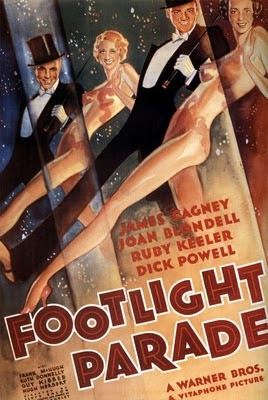 With 42nd Street and Gold Diggers of 1933 (both 1933), Warner Brothers studio had tapped into a treasure trove of entertainment for Depression weary audiences, longing for escapist fare of the highest caliber. With these fluffy film musicals, they had just that, lots of singing, lots of dancing and spectacular kaleidoscopic choreography by master showman Busby Berkley. Striking while the iron was red hot, Warners produced Footlight Parade, a cookie cutter copy of the previous shows, before the year was out. Although not exactly the same plot, the similarities were enough to continue the successful streak for Berkley and the studio.The plot, suc! h as it is, revolves around the flailing career of New York stage director Chester Kent (movie tough guy James Cagney), who, in an attempt to save his struggling production company, develops “prologuesâ€, live musical introductions to the newly popular talking pictures. As his financial woes mount, his shrewish, shallow wife demands a divorce, his competitor steals his ideas (with the help of an insider from his troupe), and his partners are swindling him of his share of the profits; add to this mix a gold-digging tootsie who latches on to his coattails when it appears he is on his way up again and you have a whirlwind of screen activity with Cagney chewing it up like it was a steak and baked potato. By his side the entire time and helping him at every turn, is his devoted and enamored secretary Nan (the incomparable Joan Blondell, at her cutest and wise-cracking snappiest).
 Cagney had become a big star at Warners, along with Edward G. Robinson, as the resident grande gangster, after his breakthrough hit The Public Enemy two years earlier. But the actor had started out on the stage as a song and dance man and took this opportunity to flaunt his hoofing skills to great success. It is in this capacity and genre that he would win an Academy Award nine years later as George M. Cohan in Yankee Doodle Dandy. In Footlight Parade, Cagney is a firecracker of activity, shooting rapid fire dialogue as quickly as he does a machine gun in his gangster/hoodlum pictures.Blondell, also a Warners staple, is a scene stealer as Nan. Standing by her man throughout the whole film (even when Cagney doesn’t realize he’s her man), she sticks up for the underdog/good guy (encouraging Chester to hire ! talented dancer/stenographer Ruby Keeler) and protects those she loves from harm (ie: pretty but conniving Claire Dodd from bossman Cagney). Along with the two leads, Footlight Parade features the fresh faces of crooner Dick Powell and the afore mentioned Keeler, who made a dynamic duo in the year’s previous two Berkley hits.
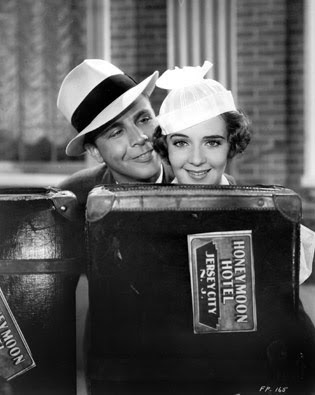 The film is pre-Code, the time before Hollywood censorship took a stronghold, and some of its racier dialogue was sliced and diced from re-release dates after the Code took effect. However, it was restored in 1970, so today, we can enjoy a classic Blondell sniping to her gold-digging rival for Cagney’s affections: “Out countess…as l! ong as there are sidewalks, you’ll have a job.†Other elem! ents tha t post-Code films wouldn’t have gotten away with were scantily clad chorines in a the bathing beauty extravaganza “By a Waterfall.†As a matter of fact, all the musical numbers in the film’s finale have daring themes to say the least. The charming “Honeymoon Hotel†routine shows a newlywed couple (Powell and Keeler) trying to enjoy their matrimonial amour without the constant interruptions that ensue, including an odd and ribald baby played by dwarf Billy Barty. In the final number, “Shanghai Lilâ€, Cagney is a sailor, looking for his lost love in the bordellos and opium dens of the Orient. It is a bizarre and surreal concept and even more unusual is the introduction of Keeler’s Lil. Unlike the debauchery and wanton behavior going on around her, Keeler, as Cagney’s Asian gal pal, is cute and perky. From the rest of the performers in the bit, one would expect Marlene Dietrich to show up as the infamous Lil. However, it is nonetheless a fabulous piece of fil! m extravagance set to music.Fast, furious and complete fun, Footlight Parade, like its toe tapping cousins, 42nd Street and Gold Diggers, was a success and continued the trend at Warners fondly known as the “backstage musicalâ€. The string would continue the following year with another installment of the “Gold Diggers†films, Dames and Wonder Bar.Want to know more?Here are some recommendations regarding the article above:Footlight Parade (1933) DVDJoan Blondell: A Life Between Takes ~ Matthew KennedyIf you are interested in these or any other merchandise, please help support this blog by purchasing them through the Amazon portal at the top of this page. By accessing Amazon through this site, you help me maintain resource material and continue to share my love of classic film. Thank you very much.
 "Confessions of a Nazi Spy" starts off as a documentary-style revelation of secret Nazi spies in the U.S. meeting and gathering information to send back to Germany. By the end it becomes less a narrative film and more a message about the dangers lurking in the dark. It's interesting enough but falls short of greatness.This 1939 release was apparently the first major studio release to attack the Nazi party, and Germany was none too happy with Warner Brothers for doing so. The foreign markets were still open, although it was becoming clear what would soon be happening. And since the film made money, other studios followed with their own Nazi-themed stories. I must admit the trailer is a lot of fun and I love ! the ending tagline, "It was our duty to make it, it's your American privilege to see it!" That's marketing gold.The movie opens without the usual credits that typified almost all movies of this time. It goes right into the silhouette of the narrator setting up the story, much like a radio announcer or radio newsman, giving everything an authentic feel to what's going to happen next. And indeed it does unfold -- an international spy ring where messages are funneled through a contact in England, where Dr. Kassel (Paul Lukas) gives rousing pro-Nazi talks to loyal Germans living in the U.S., where Germany plots how to infiltrate the U.S. and gather its secrets, where children are groomed to be good Nazis.
 The film also ma! kes it clear that a majority of Germans in the U.S. were loyal! to Amer ica. About halfway through the film G-man Ed Renard (Edward G. Robinson) is put on the case, and America can breathe easier. While Robinson is great -- I mean, what Nazi is gonna win out over Little Caesar? -- this also takes some of the wind out of the story, because Renard is so competent that the outcome is no longer in doubt. Plus, the last half hour becomes so predictable that the intriguing characters lose any dimension.In hindsight, the film would have worked better had the audience learned more about some of the characters. Why did they decide to become a spy? Why did they leave Germany in the first place? Giving them some dimension may have made the piece stronger rather than relying on black-and-white depictions of good and evil.But ultimately this film is about selling the goods, even if they are obvious. The title is a giveaway that the filmmakers are going for sensationalism. And, since this was the first film to go this route, why not? Unfortunately, 70 years l! ater, it's more of a curiosity piece than a classic with some good performance (George Sanders in particular, clearly showing the suave devil he would play so well in the future). "Confessions" is very watchable but not as daring as it once was.