 Nicole Kidman, marvelous again in Rabbit Hole.Marion Cotillard worked with Nicole Kidman on Nine, for example, but her tribute has one very insightful observation. She's talking about how, in the first moments of Rabbit Hole you know nothing about Becca's (Kidman) story but you're instantly drawn in despite her abrasiveness."Becca" is so far and yet so close at the same time. The space that is created between her and the audience is simultaneously delicate, strong, violent and full of life. A part of her is gone and will always be gone, yet you feel nothing b! ut life.
 Marion & Nic' last yearAnd when Marion concludes her tribute with...She is simply one of the world's best actresses.You have to say "amen." That's too true and a half, whether or not the actresses hit it off on musical soundstages.Reading all the articles is a pain since Variety takes such measures to hide their content but read we must. Helen Mirren loves the theatricality and imagination of Lesley Manville in Another Year, Alec Baldwin was wowed by the authenticity of the duet in Blue Valentine. And a few actors cite the cast of The Kids Are All Right. Laura Dern calls Mark Ruffalo one of her acting heroes and delivers an astute read on why he's so magical in that very difficult part (which, alas, probably won't look difficult enough to voters less discerning than Dern). Amy Ryan gives props to The Bening, par! ticular in the Joni Mitchell scene (her obvious Oscar clip, ye! s?) and Colin Firth's ode to Julianne Moore (his co-star last year in A Single Man) is wonderfully expressed. His conclusion gives me hope that The Kids Are All Right will get that "Ensemble" nomination it so richly deserves at the SAG Awards.All of the actors in this film are on the same formidable level. I kept thinking what a joy it must have been for them to all play off of each other.
 Colin & Sally. She moves him.But my favorite might be Colin Farrell's ode to Sally Hawkins in Made in Dagenham since he admits their offscreen friendship right up front but is clearly bowled over by the talent of the friend in question. Here's the fun intro. Sometimes I see a film. Sometimes I see a film that moves me. Sometimes I see a film that has a friend in it. Sometimes that friend's name is Sally. When I see a film with a friend in it and that fr! iend's name is Sally, that film moves me.I can't say that I know the feeling exactly as I have few close friends that I regularly just happen to catch on the silver screen. But I can say that I know the feeling; when I see a film with a stranger in it and that strangers name is Sally, that film moves me.Related Posts:
 - Sally 'I Beat Meryl' Hawkins
- 7 Word Review: Rabbit Hole
- Nine thoughts on Nine
- SAG Live Blog Jan 2010

Great classic films, best all time movies

 “Black Legion†is an early Humphrey Bogart film that remains stark and knowing as it explores bigotry and mob rule. This 1937 release has Bogart playing Frank Taylor, a factory work well-liked by his peers. When he loses out on a promotion to foreign-born Joe Dombrowski, who’s been going to night school to better himself, Frank is bitter and begins to direct his anger at Joe. One night on the radio, he hears discussion that “America is for Americans†and eventually gains admission into the Black Legion, a hooded, Ku Klux Klan-type group that promises to rid the world of types they deem threatening to the American way of living.This taught, well-told story comes from Warner Brothers, a studio that w! asn’t afraid to look at blue-collar life and tackle issues that were socially relevant during the 1930s. It’s not that other studios ignored such stories, but Warner Brothers did so on a regular basis. This time the issue is bigotry and white supremacy.What works is how well the film is told, with story by Robert Lord and screenplay from Abem Finkel and William Wister Haines. It’s not as sensational as “Confessions of a Nazi Spy†(thank goodness), although it can be a bit preachy toward the end. But it touches all of the right topics: the irony of this self-important group forcing members to call the leaders “sir,†eerily foreseeing a Hitler-led army of hate; the top level looking at how much money can be made from the Black Legion enterprise; the willing recruits who must profess their total devotion at gunpoint and whose hatred is essential at fueling the Legion’s success; and the ultimate pain inflicted not only on the victims but also on family members o! f both victims and Legion members.
 If the story, which can be shocking and disturbing in its continued timeliness, falls off toward the end with its sermonizing, it’s all held together by Bogart’s strong performance. This was still early in his career. He’d scored a breakthrough hit the year before in “The Petrified Forest.†During these years between “Forest†and “The Maltese Falcon's†release in 1941, Bogart worked hard and developed his craft. It’s clear in “Legion†what a good actor he was becoming. Frank Taylor is a character the audience has to like in order to follow his descent into hatred. Bogart beautifully plays the conflict â€" the well-liked employee to the swagger of inclusive righteousness to self-loathing at what this has cost him. It’s gr! eat character work from a magnetic star, and it’s fascinating to watch him be so good this early in his career.The solid supporting cast includes another Warners star, Ann Sheridan, early in her career. There’s also a mature musical score by an uncredited Bernhard Kaun.“Black Legion†remains a potent film from a studio willing to play to its strengths. Warners was never as glossy as MGM or Paramount during this period, but the studio was no less important with films like this. Check it out, because "Legion" is as relevant with its take on hate crimes.
 In addition, during this holiday season, check out "Humphrey Bogart: The Essential Collection," a 13-disc DVD set with 24 Bogart films from the 1930s and 1! 940s as well as “The Brothers Warner†documentary. It has ! plenty o f commentaries and featurettes, and I like how the movies are also packaged as “a night at the movies†old-school style, complete with shorts and trailers.All of the major titles from this period are included, from “Maltese Falcon†to “Casablanca†to “Treasure of the Sierra Madre†to his films with wife Lauren Bacall. It makes a great gift for classic movie-lovers.It also made me realize how many films of Bogart’s I haven’t seen. I’ll start working my way through them and perhaps in 2011 post several of them.Warner Brothers Online
 Recommended Songs: I would say her an entire album(The Family Jewels) but if you want to hear her absolute best, then I would sugges! t listening to either, "I am Not a Robot", or "Oh No!"2. If I could be any two characters, from any movie, they would be: Nora Charles in "The Thin Man'' and Ann Lemp in "Four Daughters". 3. Favorite Leading Man of the 1940's(Not Including Jeffrey Lynn!) would definitely be Cary Grant, Robert Cummings, and William Prince.
 4. Two actors, that I wish could have worked together would be Myrna Loy and Humphrey Bogart, Myrna Loy and Jeffrey Lynn, and Jeffrey Lynn and Jean Harlow 5. The 1930's are my favorite style decade, with the 1960's close behind.6. If I could steal away any Myrna Loy look, it would be her amazingly brilliant striped dress, she wore in "The Thin Man". As a matter of fact, I would steal her entire wardrobe from that film. 7. I pr! efer watching Jeffrey Lynn in his more comedic roles, such as ! his role in "Four Daughters" or his very uptight role in "It All Came True". Even when his character is tensed up, the environment of the film is lighthearted. 8. I survive solely on these four shows: "CSI", "Infomania", "Deadly Women", and "Glee".( I confess to being an informative Deadly CSIer Gleek and I'm quite proud to admit it!) 9. I will NEVER read or watch anything to do with "Twilight". All I have to say to that is, BLEH!10. I HATE HATE HATE Peanut Butter!I know, you were not expecting that last one, were you???? Hahaha :D It's all in good fun, so if you want to join in, come on and have some fun! ;)
 Talented but temperamental actress Miriam Hopkins had the reputation of stealing scenes and chewing scenery throughout her prominent career. Her earliest days onscreen were no exception and as a bright and shiny new star at Paramount in the early 1930’s, she did not hide her light under a bushel. Making her film debut in 1930 in Fast and Loose with fellow Paramount pretty Carole Lombard ( Lombard had been in films for over half a decade by then), she had a hit in her second feature The Smiling Lieutenant (1931) co-starring movie novice Claudette Colbert. By her third film, she was the sure fire star of the show, even though Clive Brook and Kay Francis were billed ab! ove her. The film was called 24 Hours, and it was a prime example of pre-Code Paramount, with a great line-up of actors to boot.
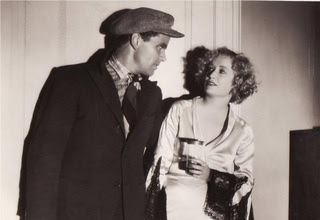 Jim and Fanny Towner (Brook and Francis) are a wealthy yet bored couple who are each involved in an extramarital affair. Jim’s alcoholism doesn’t help the problem and he finds solace with his paramour Rosie Duggan (Hopkins), a brassy speak easy singer, who is married to a weak and neurotic small time hoodlum named Tony (Regis Toomey, whose 40 year screen career began the year before this film was made). Tony is on the skids after his wife has the bouncer at the club where she works, toss him out on his keyster. Later that evening, she carries the! falling down drunk Jim home with her to see that he sleeps of! f his bu zz. When Tony comes aknockin’ in the middle of the night, crazed look in his eyes, he accidentally kills the two-timing torch singer, while her sugar daddy is passed out in the other room. He beats it when he realizes what he’s done, as does Jim when he awakes the next morning and realizes he could be blamed for the chanteuse’s demise.
 As much as a dramatic showcase 24 Hours is for Miriam Hopkins, Kay Francis has the tougher job of giving a more subtle yet still effective performance. To an extent she succeeds, but her character is written so that she has little more to do than look forlorn about the lack of love in both her marriage as well as her affair. Her dramatic gl! ory days would come with her tenure at Warner Brothers a few years later, a working relationship that was both extremely profitable as well as turbulent for the raven haired star. British born Clive Brook worked in silent films for years and made the transition to sound successfully. He looks rather bored in the first half of this film, but I suppose that is his job, as he is bored with his life AND his wife. (Brook made a telling statement about his profession in America when he said: "Hollywood is a chain gang and we lose the will to escape. The links of the chain are not forged with cruelties but with luxuries."). Although given a small role, veteran stage actress Lucille LaVerne gives the audience a visual once-over as Tony’s slovenly and tough-as-nails landlady. I recognized immediately her voice as that of the old hag in Walt Disney’s animated masterpiece Snow White and the Seven Dwarfs (1937). It was the last performance of her very lengthy caree! r, and the one for which she is most associated, as the animat! ors actu ally used the actress as a visual model for the crone.Based on the novel Twenty-Four Hours by Louis Bromfield, the film is a lost gem, a part of Paramount’s film library, owned by Universal/MCA, most of which are unreleased to the general public. Copies aren’t easy to find and when they are, the quality sometimes has much to be desired, but if you do get a chance to gander the charms of the young Mesdames Hopkins and Francis, I’d jump at it.