 About a year ago, I wrote a short piece on the legendary feud of two legendary Hollywood actresses, Bette Davis and Miriam Hopkins. Since then, I have expanded this forum and also, delved deeper into the abyss that was the Davis/Hopkins relationship. Bette was infamous for her battles with certain co-stars, male (paging Mr. Flynn! Mr. Errol Flynn!) as well as female (calling Joan Crawford!), but they seemed to pale in comparison to her feeling for Miriam Hopkins. Their’s was a deep seeded, long standing rivalry, which began even before either woman made a single movie.Round 1In 1928 both young actresses were in a stage production on the east coast called Exc! ess Baggage. Both were part of a repertory acting company headed by director George Cukor, although at this point, unlike their future film pairings, Miriam, not Bette, was the big cheese. Hopkins also made leading lady status in Hollywood long before Davis, with star turns in Dr. Jekyll and Mr. Hyde (1931) and Design for Living (1933), among other notable films of the early 30’s.
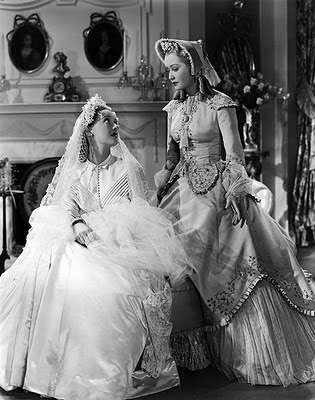 Round 2In 1933, Hopkins starred in Jezebel on Broadway. It was the story of a tempestuous Southern belle (a part tailor made for the real life Southern spitfire) in the era before the Civil War, ala Scarlett O’Hara. The play was unsuccessful, running only a ! few dozen performances and closing after a month. Not only did! Miriam star in the play, but she was part owner of the rights to it. When Warner Brothers studio showed interest in the story as a vehicle for its rising star, none other than Miss Bette Davis, Hopkins balked, refusing to sell the rights unless the deal included her in the lead role of Julie, which she had originated. In order to obtain the rights, she was given the impression that she would be cast, so when top brass gave the plum part to Davis, Miriam was livid. To add insult to injury, Bette won her second Oscar for her performance in Jezebel. The story goes that Miriam cried.Round 3In late 1938, with her career in somewhat limbo, Hopkins signed a two picture deal with Warner Brothers. The first film under her new contract was the historical melodrama The Old Maid (1939), based on an Edith Wharton story. In the film, she played second lead to guess who….Bette Davis, Warners reigning queen supreme. But neither actress was a shrinking violet and! there was tension aplenty on the set, with director Edmund Goulding at the helm. A studio memo summed up the stressful situation when it relayed, “…Goulding has a tough job on this picture with these two girls. Not that they want to cause him any trouble or worry, but each one is fighting for a scene when they go into it…â€Davis had fought hard with the studio to get where she was professionally, and she wasn’t about to take guff from her rival. But Miriam certainly tried to get a rise out of her at any opportunity. On her first day on the set, Hopkins wore an exact duplicate of the dress Davis had worn in Jezebel. Davis reflected on this time with Hopkins in her autobiography with the following observations: “Miriam used and, I must give her credit, knew every trick in the book. I became fascinated watching them appear one by one…When she was supposed to be listening to me, her eyes would wander off into some other world in which she was the ! sweetest of them all. Her restless little spirit was impatient! ly await ing her next line, her golden curls quivering with expectancy."
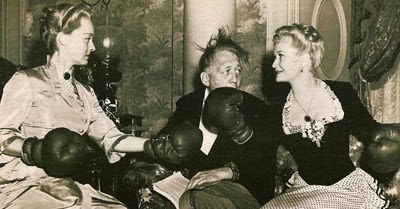 Warner Brothers publicity department took full advantage of the dueling divas and played up their feud to boost ticket sales for the upcoming film. They even went as far as to circulate a photo of the actresses in full costume with boxing gloves on, ready to duke it out, with director Goulding looking resigned between them. (above)Round 4During the making of The Old Maid, Hopkins was married to director Anatole Litvak. Litvak had directed Bette Davis in her follow up film to Jezebel called The Sisters (1938), and Miriam suspected the two were having an affair,! but Davis was too taken with her Jezebel director, William Wyler, at the time to look at Litvak. However, reportedly Litvak and Davis DID have a short affair during the filming of All This and Heaven Too in 1940, but by that time the director and Hopkins had already divorced.The Old Maid was excellent box office, and Warners signed Miriam on for another spin with her nemesis in 1943 to make Old Acquaintance, the story of two childhood friends/rivals who spar incessantly over men, career, and a child. The romantic yarn was perfect for the pair, but wasn’t without its backstage fireworks. Edmund Goulding was again slated to direct but had a heart attack shortly into the production. Knowing the emotional state of the set and the stress Goulding had been under with the two high maintenance queens, studio head Jack Warner jokingly accused him of having the heart attack on purpose. At 40, the dew was off the l! ily for Miriam, and when production wrapped on Old Acq! uaintanc e, she sold her house in California, packed her bags and went back east to the stage. When she returned to Hollywood, it would be in character roles over half a decade later.

Great classic films, best all time movies

 MGM set sail in 1935 with "China Seas," an exotic trip from Hong Kong to Singapore -- although no one left the back lot. Still, the stars were out in full force, and producer Irving Thalberg kept everything moving full steam ahead, which keeps this film from capsizing.OK, how many bad boat metaphors can I use in one lead?Actually, think "Grand Hotel" meets "Mutiny on the Bounty." While it's not as good as either of these films, "China Seas" works in spite of itself. The stars look fabulous, the dialogue clips along at a fast pace, the action scenes are exciting, and the audience can just sit back and forget the fact that story is pretty flimsy. It's worth noting that Thalberg had produced "Grand Hotel" in 1932, which ! featured for an unheard-of five top-line actors and multiple story lines going at once. The formula works even today, and in the years following "Grand Hotel's" success, MGM wasn't afraid to tap into its vast acting pool and bring together that much talent for a film. "Dinner at Eight" from 1933 is a good example, and this film follows suit with three stars and story lines to spare. Thalberg knew that star power can detract from lesser material.The movie opens by introducing all of the various characters and plotlines -- and there are TONS of plotlines, big and small, for a 90-minute film. It's like every nook and cranny of the ship is filled with some intrigue. You've got Captain Alan Gaskell (Clark Gable), arriving somewhat drunk yet feared by his crew for being an unrelenting taskmaster. He's broken off with the earthy Dolly (Jean Harlow) in port, although she's decided to book passage to be near him. He then runs into Sybil (Rosalind Russell), a classy woman he befriend! ed years ago, and he pursues a romance with her. In retaliatio! n, Dolly works with Jamesy MacArdle (Wallace Beery), who is in cahoots with a band of pirates wanting to steal a secret gold shipment that's on board.These are the main plotlines. Then you have Davids (Lewis Stone), a fallen captain detested by the others for being a coward who Gaskell hires to be third officer; a female passenger with fake pearls she's trying to hide from her husband and a man blackmailing her; and McCaleb (Robert Benchley) as an author who's constantly inebriated. A few other minor characters are around for color and you've got to keep track of a lot.
 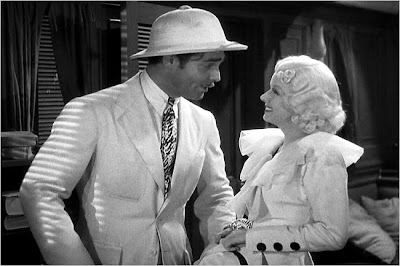 The plotting gets to be too much at first, and the romantic triangle isn't all that intriguing. Once you get to the action, though, the movie picks up. ! A typhoon and a pirate raid provide plenty of excitement, and the second half of the film is really quite fun.Plus there's plenty of focus on the stars. Harlow plays the dame -- typecast once again. But she does it with so much energy that it's hard to resist. The film cuts awkwardly at times to her closeups that clearly look like they were shot at a different time than the rest of the scenes, almost saying "here's the gratuitous star closeup for her fans." But what would a Harlow film be without a few gorgeous closeups of its star?Gable looks even more handsome and dashing than usual. His charisma is fully in use here -- he gets to be hero, lover and tough guy. Plus there's a chance to see him in an undershirt and a sleek black knit long-sleeve shirt during the typhoon that ups the swoon factor.Beery, like Harlow, plays the same type of character in his films. Usually they are earthy or men who have made something of themselves but are rarely polished. There's no exception! here. Gable, Harlow and Beery were all established stars at t! his poin t, and MGM knew it and draws on that star power here.On the other hand, Russell was just beginning her long movie career. For anyone who's enjoyed the force of her comedic skills or the strength of her dramatic talents, she's simply playing a throwaway role here -- the love interest, and one who is secondary to Harlow. Russell doesn't have much to do, but I don't think MGM knew what to make of her yet. Thankfully, that would change.During the past year, I've been watching a lot of MGM films from the 1930s, and I'm enjoying seeing how the great studio managed to turn out so many likable films, whether they were truly great or simply enjoyable like this one. MGM had the stars and instructed its directors and cameramen to make their stars look amazing, even if their characters weren't glamorous. This is a film where the studio's know-how is on full display.Or, really, it's Thalberg's touch at work once again. This was one of his first films after a long hiatus from the studio d! ue to his health. He was on the "China Seas" set constantly, giving advice to the actors, until director Tay Garnett confronted him and pointed out that Thalberg was undermining his authority. Thalberg immediately stepped back and thanked Garnett for being open and honest about it. This is one of the stories that makes me appreciate Thalberg. He was a genius, but he also tried to treat people with respect.
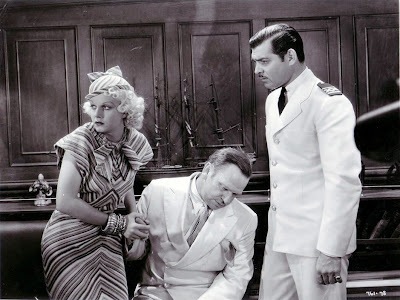 So, with "China Seas" you've got MGM in the 1930s with Thalberg as producer and Gable, Harlow and Beery as stars. What's not to like about this crew?
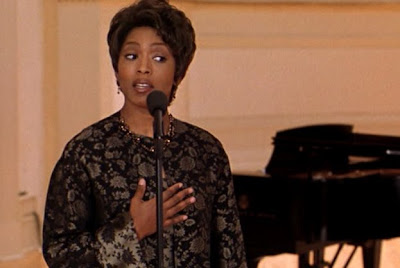 "I want to thank each of you for your generous support and I sincerely hope that you enjoy the blog post."If you need someone to introduce something, you choose Angela Bassett. It's the only way to go. She will always e•nun•ci•ate for you. I lead off with Angela's intro to the concert which concludes Music of the Heart because this is the sort of film that is entirely about its heartwarming climax. In fact, when it comes to movie narratives, the Inspirational True Story is the subgenre that most begs a swift telling. Inspirational Stories are about inevitable! triumphs. The audience knows it's coming so too much dilly-dallying is deadly.Music of the Heart tells the story of Roberta Guaspari (Meryl Streep) who started a violin program in East Harlem. The program was forever endangered due to a lack of funding for arts education (same as it ever was), but it changed the lives of Roberta, her family, and thousands of students while it lasted.
 <-- Streep with her screen son (Michael Angaro way back when!) When we first meet Roberta she's angry and red eyed, tearing up photos and screaming out the window at movers. Her husband has recently left her and she's moving back in with her mother (Cloris Leachman). With the help of her pushy mom and an old school friend who always had the hot! s for her (Aidan Quinn) she crawls towards a new life. She win! s a teac hing job from an East Harlem principal (Angela Bassett) who's impressed by her talent and chutzpah. We spend the rest of the movie watching Roberta find her footing as a single mom, teacher, and Inspirational True Person.Like The River Wild (previously discussed), the simplistic story is complicated by Streep's detailed characterization. We know when Roberta is worried, turned on, sad, relieved, amused or angry... and she's often angry though Streep is careful to delineate the varieties thereof. Streep's violin skills won attention during the film's release -- is there anything she can't do or pick up quickly should a role require it? -- but that's a technical aspect of the performance that's a necessity rather than an interesting character interpretation. The most intriguing element of her performance is undoubtedly the push and pull between her meek wifely persona and the iron willed single woman she's forcing herself to become. You can feel this especially in the arc of h! er relationship with Aidan Quinn. Though he's helping her move forward into her new persona, she often seems to be retreating in his presence, replaying her marriage as it were.Though it's not often discussed when praising her work, Streep's always been particularly skilled at conveying external romantic arcs and the erotic internal (which will hopefully serve her well in Great Hope Springs). I don't mean this in a garish "I'm sexy!" way but in a grounded flesh and blood way. She can hit all the notes that any good actor can about sexual attraction but she also drops enough conflicting suggestions into her performances to keep you guessing about how much Character A likes being with, romantically loves and desires to have sex with Character B and how consistently or deeply she feels or has ever felt those things and whether those types of love are satisfyingly portioned out. If you stop to think about romances, isn't that far more truthful than merely portraying attraction ! or the lack of it.
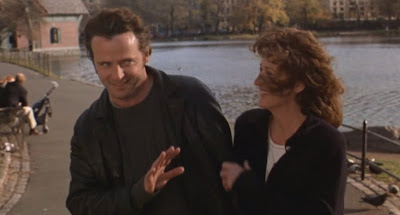 "Whoa. Slow down here a minute.That's a little too much like getting married."But it's strange to talk about how much she does or doesn't want to have sex with Aidan Quinn in Music of the Heart, because A) who wouldn't? and B) she's playing this romance while entirely buried in Wal-Mart's Old Maid line. Question for all: Is Roberta Streep's frumpiest character? You'd barely know she had breasts or hips underneath all those layers and heavy ankle length dresses. Roberta barely remembers that she has them either, given that her two sons are forced to play matchmaker in the second act.About that second act. Music of the Heart is more enjoyable than its reputation suggests but it does lose considerable steam when it jumps forward ten years. There's a fun moment sho! rtly before the movie's phantom intermission when Roberta conspiratorially teaches her students to make the audience wait for the final notes of a song. The promised moment of silence and release in the mini-concert is quite a satisfying finish. (There's even a slo-mo fadeout like the movie is ending!) Until, you realize, that was only the curtain on Act 1. You've now seen Roberta triumph over her past meek self, lazy students, disbelieving faculty, and her commitment-phobic boyfriend. Now, you'll watch her triumph all over again but on a larger scale.
 Roberta's artful baiting , that "wait for it..." theatrical finish, only lasts a few beats. Craven's "wait for it" finish involves a whole second movie. Roberta teach her student! s discipline. Wes Craven, taking a rare step outside the horro! r genre for this true story, merely tests his audience's patience.Music of the Heart is moving, yes. I teared up, I did. But what Inspirational True Story involving kids and learning isn't? Streep makes a valiant effort with Roberta, though, and her sensitive performance is the best and arguably only reason to see this inelegantly structured, awkwardly told story. ♫As you may know, Music of the Heart netted Streep her 12th nomination. Some context now.That honor tied Katharine Hepburn's nomination record and kept Jack Nicholson permanently at bay (the next time he was nominated, she was too). It took Hepburn 49 years to win 12 nominations. Streep did it in only 21. Hepburn is still the champ for Oscar wins with 4 competitive statues to her name. Streep's insane nomination record is working against her when it comes to actual wins. When you're nominated in more than 50% of the Oscar races in your working lifetime -- she has been -- what incentive do they have to give you yet more r! ecognition in the form of a win?for 1999 the nominees were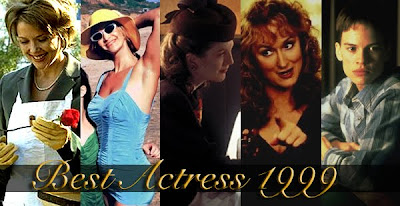


 Caravaggio (86, debut) | The Last of England (88) | Edward II (91)
 The Beach (00)| The Deep End (01) | Teknolust (02)
 Young Adam (03) | The Chronicles of Narnia (05) | Stephanie Daley (06)
 Michael Clayton (07) | Julia (08) | I Am Love (10)That's not the complete filmography but the lead roles and a few key / essential supporting gigs. There's many more smaller roles. She's not at all afraid of a crowded ensemble film or a blink and you'll miss her cameo. The best of the latter is probably Love is the Devil. And even if you don't blink you might miss her in that rough trade art biopic (starring Derek Jacobi & Daniel Craig) because she's so shockingly unrecognizable in it.How many of those 15 have you seen? Which are your favorites?I AM LOVE is an absolute must see for Tilda fans and art film aficionados in general. The film opened in LA and NYC last weekend and adds more cities today. Did it hit your town yet?previously on Posterized: Tom Hanks, Will Smith, Angelina Jolie, Viggo Mortensen, Cate Blanchett and Barbra Streisand.